Shop by Brand
7 dewatering and filter belts with pictures, part numbers and data sheets. Choose a brand to see its belts.


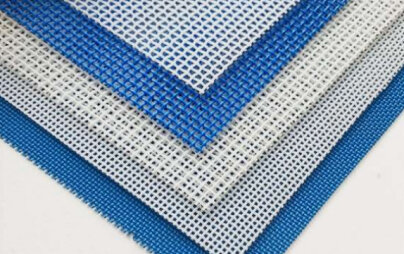
Dewatering mesh belts are woven from polyester monofilament in plain, twill and multi-layer weaves; the weave and air permeability set how fast water drains and how many fines are retained. They are joined with clipper or pin seams so they can be installed on the press.
Rubber vacuum filter belts carry the filter cloth over a vacuum box: grooves (V, round or U) in the top cover lead liquid to drainage holes, and bottom guides keep the holes centered over the vacuum chamber. Air-permeable belts let air through to fluidize powders in silo, railcar and trailer live bottoms.
Materials & Covers
Temperatures are typical continuous ranges; each belt's data sheet gives the exact rating.
| Material | Properties | Temperature | Typical use |
|---|---|---|---|
| Polyester monofilament mesh | Woven plain, twill, multi-layer and spiral link; set by permeability (CFM). | approx. up to 250°F (grade) | Belt filter presses, sludge, paper, food |
| Rubber vacuum filter belts | Grooved, drilled, with skirts and bottom guides; fabric-free zones protect the carcass. | compound dependent | Mining, chemical, flue gas (gypsum), pulp |
| Needled polyester (non-woven) | Air permeable, rated 0.5 and 1.5 CFM. | grade dependent | Dry bulk live bottoms, air slides |
| Solid woven polyester | Low and high permeability air-slide fabrics. | grade dependent | Cement, flour, fly ash |
| Polyester / Kevlar® | High-temperature air-permeable fabric. | high temperature grades | Hot powders |
Constructions, Surfaces & Fabrication
Every belt is cut to width and length and finished in our shop or on your line.
Constructions
- Single, double and triple layer weaves
- Spiral link mesh
- Clipper, pin and stainless seams
- Rubber filter belts with V, round or U grooves
- Fabric-free zones and molded skirts
Surfaces & profiles
- Plain weave
- Twill
- Heat-set and calendered
Fabrication options
- Seaming (clipper, pin, spiral)
- Edge sealing
- Drainage holes and grooving
- Bottom guides
- Skirts
- Rubber wear belts for vacuum channels
Applications
- Municipal and industrial sludge presses
- Pulp and paper
- Mining and minerals
- Power plant gypsum and fly ash
- Food and fruit juice
- Dry bulk silos, railcars and trailers
Manufacturers
We source this belt type from these manufacturers and match equivalents across brands.
Frequently Asked
What do you need to quote a filter press belt?
Press make and model, belt width and length, seam type, mesh or permeability (CFM) of the current belt and the application. A photo of the belt label helps.
Other Belt Types
Light Duty BeltingPower Turn Belts (ProTurn)Live Roller BeltsHeavy PVC BeltingHeavy Rubber BeltingLight Duty Rubber BeltingFlat Power Transmission BeltsZipLink & Spiral-Joint BeltsHeavy Rubber Wall BeltingPolyurethane Monolithic BeltsPolyurethane Timing BeltsHigh Temperature BeltingAir Permeable & Non-Woven BeltsStainless Steel Mesh BeltingModular plastic beltsTiming & V-beltsSplicing & field service